 Back


Why Safety Training Is Important for Construction Companies

By Jordan Thomas - Senior Safety Training Manager
10 mins read
Safety training is crucial for construction companies because it protects workers, equipment and structures from potential accidents. It may be tempting to skip or minimize safety training, but maintaining a safe workplace is one of the best ways to reduce losses and avoid penalties or fines. Here is Herc Rentals' guide for prioritizing safety in construction applications.
Key Takeaways
- Safety training for construction companies helps prevent accidents, rework and legal repercussions.
- Employees need ongoing training to refresh their knowledge and maintain safety priorities.
- Construction safety training should cover the prevention of falls, struck-by accidents, electrical hazards, hazardous material exposure and confined space risks.
- Maintaining documentation and ongoing evaluation is a vital part of a comprehensive training approach.
What Are the Benefits of Safety Training for Construction Companies?
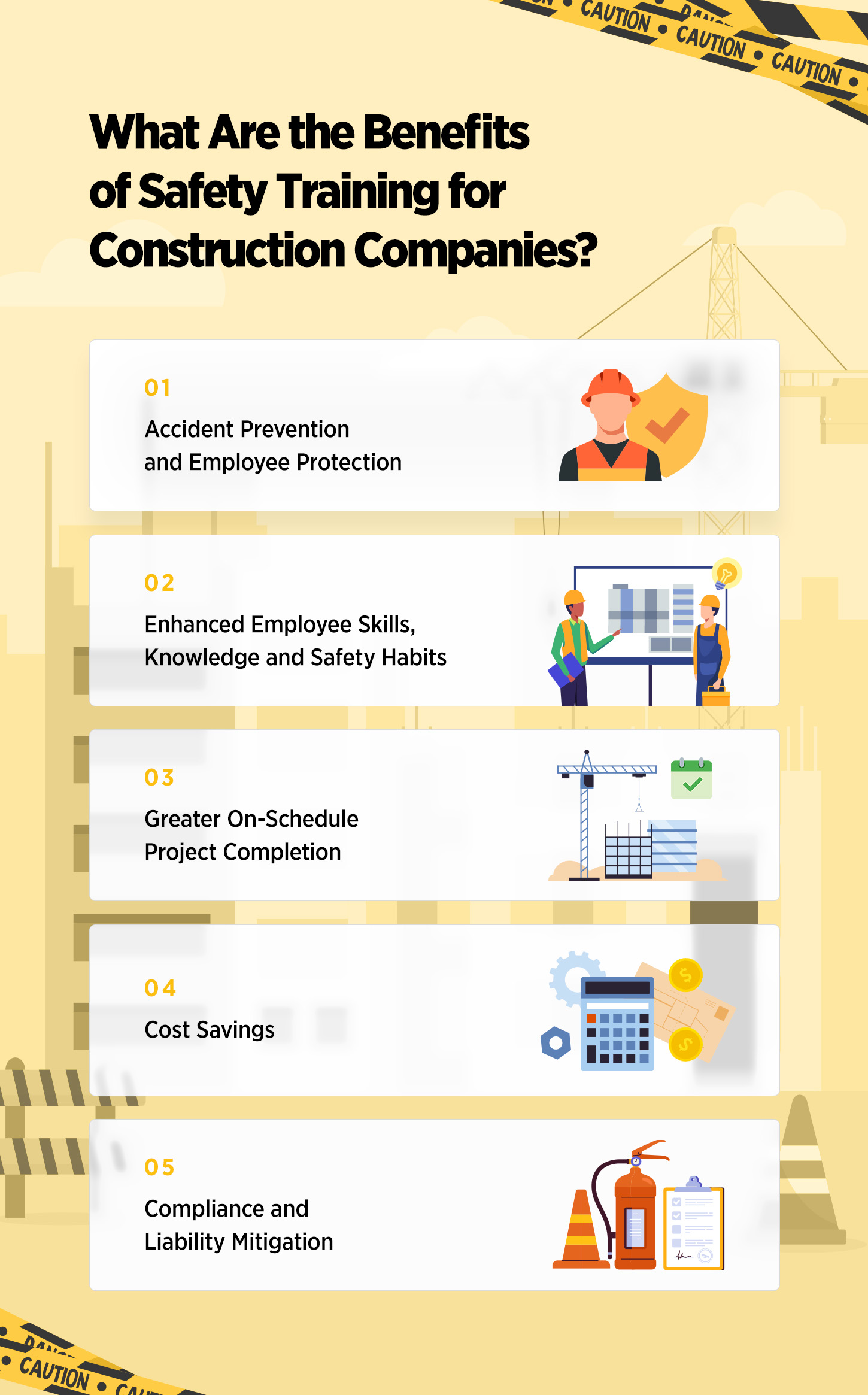
Safety training is vital for construction companies because it offers the following benefits.
Accident Prevention and Employee Protection
Construction companies are responsible for protecting employees on the job, and training is a vital part of maintaining a safe work environment. Safety on construction sites is a joint responsibility, which means that prime contractors and subcontractors must prioritize safe practices, even when liability is contractually shifted. Training is vital because it helps prevent common construction accidents, such as:
- Falling objects
- Falls from equipment or scaffolding
- Injuries from equipment
- Vehicle accidents
- Exposure to potentially harmful materials or substances
- Dust inhalation
- Lifting heavy objects or loads
Enhanced Employee Skills, Knowledge and Safety Habits
It's a common misconception that construction safety is common sense and remains at the top of every worker's mind. Every construction team member needs thorough training and ongoing reminders to reinforce safe practices.
A worker may be unfamiliar with basic safety precautions, equipment protocols or nuanced best practices across different types of construction sites. For example, a worker who usually works on paving or excavation may not think about the proper precautions when switching to tasks at different heights or using an aerial lift for the first time. Workers need to understand the safest ways to move around the construction site, operate equipment, use tools and remain aware of their surroundings.
It's also easy for workers to forget the importance of safe practices, and ongoing training helps them remember to integrate safety into their daily processes every time.
Greater On-Schedule Project Completion
Some construction managers believe that safety training delays projects, but adequate training actually helps keep projects on schedule. While training takes time, it helps workers complete tasks correctly and avoid the need for re-work. Comprehensive safety training is a more effective way to save construction crews time than cutting corners and risking potential mistakes.
Cost Savings
Investing in comprehensive safety training can also help your company save money over time, as it helps reduce Total Recordable Incident Rate (TRIR) and Days Away, Restricted or Transferred (DART) cases. When you work to minimize accidents, you can directly lower workers' compensation insurance premiums, eliminate costly equipment damage, prevent downtime and protect profit margins.
Compliance and Liability Mitigation
The OSH Act of 1970 grants workers the right to safe working conditions and the necessary training to prevent workplace injuries. Having a training program in place can help your team maintain compliance with OSHA regulations and reduce the risk of preventable violations or fines.
The OSHA Outreach Training Program is a voluntary program often used by companies and mandated in certain states and local regulations. Federal OSHA standards also require specific-hazard training for workplace injury prevention.
What Types of Training Do Construction Workers Need?
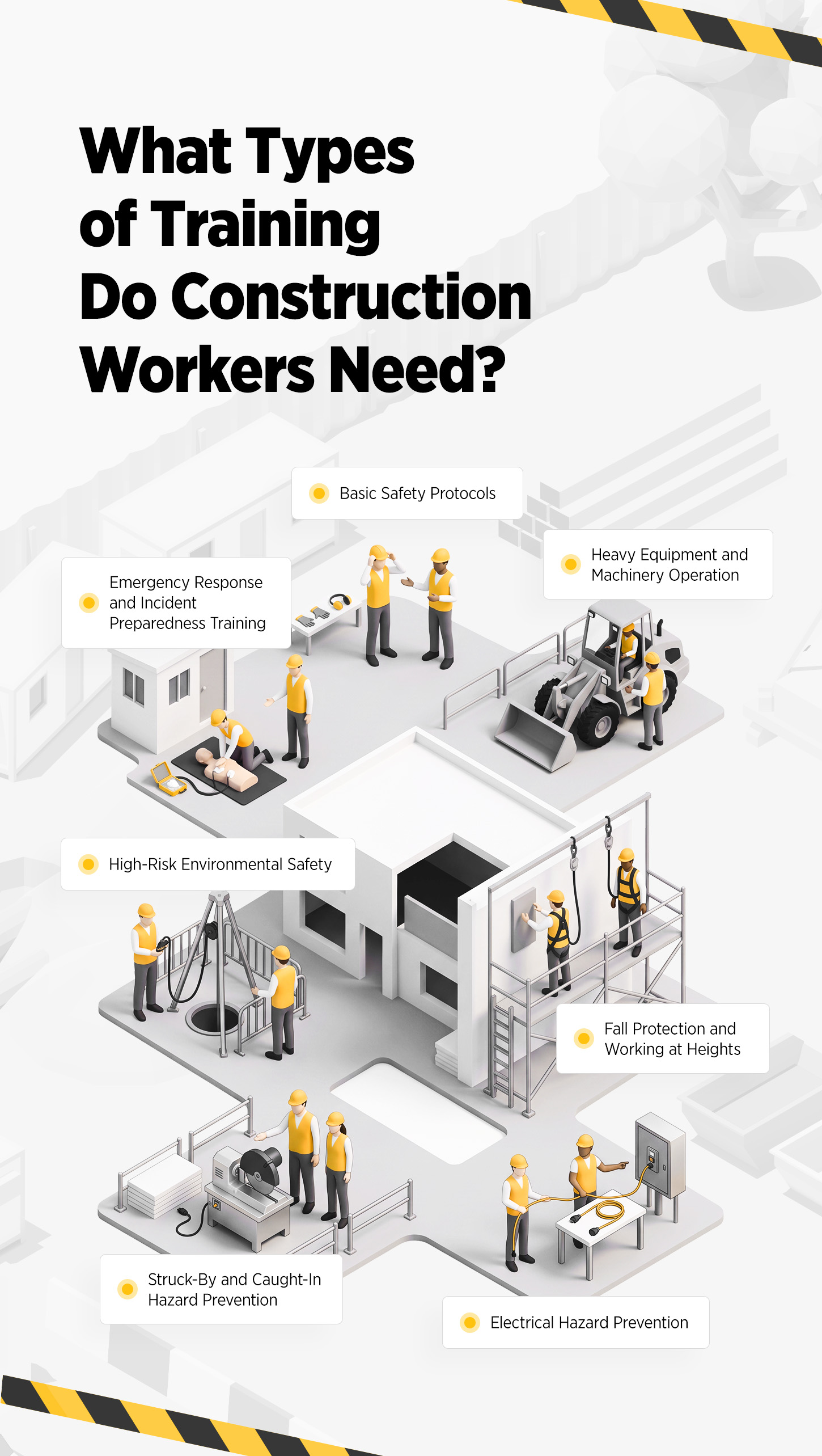
The type of training a construction worker needs depends on the specific tasks they complete and the equipment they operate. Here are some of the most important training categories for construction crews.
Basic Safety Protocols
Onboarding new hires and subcontractors before they step onto an active jobsite helps everyone understand basic personal protective equipment (PPE) requirements, emergency evacuation routes and unique project hazards. Site-specific orientations and health and safety (H&S) inductions ensure that even veteran workers immediately grasp the specific escape routes, hazard zones and rules unique to a new project.
Heavy Equipment and Machinery Operation
Heavy equipment and machinery operation training is essential for preventing catastrophic tip-overs, collisions and struck-by accidents that account for a significant share of jobsite injuries and fatalities. It provides operators with the knowledge of pre-operation inspections, load stability principles and terrain navigation so they can work efficiently and in full compliance with safety standards. Workers need thorough training to operate equipment such as:
- Scissor and boom lifts
- Skid steers
- Wheel loaders
- Backhoes
- Bucket trucks
- Excavators and compact excavators
- Utility vehicles (UTVs)
- Material handling equipment such as warehouse forklifts, rough terrain forklifts, electric pallet jacks and telehandlers
Fall Protection and Working at Heights
Training workers how to work at heights safely is vital because falls are one of the leading causes of fatalities in the construction industry. Specialized fall protection training programs help workers understand regulatory standards, recognize potential hazards and learn how to correctly select and inspect personal fall arrest systems to prevent catastrophic incidents.
In addition to courses on fall protection and working at heights, you can find courses that cover safe scaffold building and inspection, safe scaffold usage and safe scissor and boom operation.
Electrical Hazard Prevention
Training workers to recognize electrical hazards is an effective way to prevent severe injuries and fatalities caused by contact with live wires, faulty equipment or overhead power lines. Specialized electrical safety training helps workers understand safe approach distances, proper ground-fault circuit interrupter (GFCI) usage and rigorous inspection protocols for extension cords and ungrounded tools.
In addition to general electrical awareness, crews benefit from training that covers safe work practices around temporary jobsite power distribution and electrical panel operations.
Struck-By and Caught-In Hazard Prevention
Struck-by and caught-in or caught-between hazards account for a massive share of jobsite injuries. Targeted training programs teach workers how to maintain safe buffer zones around moving vehicles, secure loose tools and navigate visibility gaps around heavy machinery. Workers should also learn how to identify crushing risks around rotating equipment, unguarded mechanical parts and unstable trench excavations to prevent serious accidents.
High-Risk Environmental Safety
High-risk environmental safety training is essential for mitigating invisible and immediately dangerous hazards such as toxic gases, structural collapses and oxygen-deficient atmospheres in confined spaces or trenches. It equips workers and competent persons with specialized hazard recognition, atmospheric testing and emergency rescue planning protocols to prevent fatal incidents in hazardous environments.
Emergency Response and Incident Preparedness Training
While accident prevention is the primary goal, comprehensive safety training must also prepare your crew for what happens when things go wrong. Emergency response training prepares workers to act decisively in critical moments to minimize injuries and save lives:
- Fire safety and evacuation: Training on site-specific evacuation routes, assembly points and the proper use of portable fire extinguishers for early-stage fires.
- Rapid crisis response: Specialized protocols for reacting swiftly to high-consequence emergencies, such as trench cave-ins, structural collapses or severe heat stroke incidents.
- First aid and medical certification: Keeping a designated percentage of your crew and site leaders current on first aid and CPR certifications and trained in the operation of automated external defibrillators (AEDs) before work begins.
The Importance of Equipping Supervisors to Adequately Train Construction Crews
Safety leadership is essential for anyone who has the authority to stop work, conduct daily hazard assessments and ensure regulatory adherence on-site.
While comprehensive corporate safety programs establish the baseline for regulatory compliance, construction site leaders serve as the daily bridge between written policies and field execution. Equip your company's leaders with advanced training skills because it's their job to shape worker behavior, correct unsafe habits in real time and foster an environment where teams openly discuss safety rather than treating it as a checklist item.
Providing Clear, Actionable Guidance
When supervisors deeply understand technical safety protocols and adult learning principles, they can translate complex OSHA standards into clear, actionable guidance during daily safety talks and pre-job briefings. Beyond general supervision, federal regulations and industry best practices require each designated “competent person” on a construction site to have specific, advanced preparation. A competent person is a leader capable of:
- Identifying existing and predictable hazards on jobsites.
- Recognizing working conditions that are hazardous to employees.
- Promptly eliminating hazards and unsafe working conditions.
Whether overseeing excavation shoring, scaffold erection or crane operations, a competent person is legally responsible for stopping work immediately when hazardous conditions arise. Training programs tailored for competent persons focus heavily on hazard recognition, atmospheric testing, structural stability principles and the enforcement of safety controls across diverse subcontractor teams.
Building Consistent Safety Integration That Impacts the Entire Company
When your company invests in training the leadership tier, the positive effects impact the entire organization. Supervisors confident in their safety knowledge communicate more effectively with field crews, build higher levels of trust and encourage workers to report near-misses without fear of reprisal. This leadership-driven approach enables teams to consistently apply safety protocols from the top down, which reduces human error, mitigates liability and ultimately creates a safer, more resilient workforce on every project.
Cultivating a Proactive Safety Culture Through Continuous Engagement
A proactive safety culture helps your company embed safety into the daily rhythm of every project rather than treating it as an afterthought or a box-ticking exercise. Use the following tips to build this culture.
Encourage Active Participation
Move away from top-down mandates and invite active worker participation at every level instead. When field crews feel that their frontline experiences are valued, they are far more likely to take ownership of site safety. Listen to frontline worker feedback, and integrate it directly into site safety plans when applicable.
Conduct Daily Toolbox Talks
Daily interactive toolbox talks keep safety at the forefront of workers' minds. Try to keep toolbox talks relevant to the day's specific tasks. This is much more effective than reading generic policy statements, as supervisors can use these brief morning meetings to discuss recent near-misses, demonstrate the proper inspection of personal protective equipment and invite crew members to share observations about emerging jobsite risks.
Reward Near-Miss Reporting
Providing blame-free and non-retaliatory reporting channels gives workers the opportunity to flag unsafe conditions or equipment malfunctions without fear of retaliation. When you treat near-misses as learning opportunities rather than occasions for blame, you create an atmosphere of mutual trust between leaders and workers. This approach allows teams to catch and correct hazards long before an accident occurs.
How to Maintain Training Documentation and Continuous Evaluation
Maintaining meticulous training records is just as important for legal protection and operational integrity as delivering effective safety training. Tracking certifications, equipment qualifications, OSHA Outreach course completion cards and site-specific inductions can become complex in the fast-paced construction industry, especially when managing rotating crews and subcontractors. The following practices can help you track documentation and maintain continuous evaluation efficiently.
Establish a Digital, Centralized Record-Keeping System
A centralized record-keeping system enables safety directors to instantly verify whether a worker is certified to operate heavy machinery or perform specialized tasks at heights before they step onto an active jobsite. This proactive documentation provides an essential safeguard during OSHA audits, insurance reviews and legal disputes. It helps demonstrate that your organization has fulfilled its legal and ethical responsibilities to train personnel and enforce safety standards.
Adopt Automated Tracking Solutions and Designate a Safety Administrator
Robust record-keeping requires you to move away from fragmented paper logs and adopt automated tracking solutions. Automated solutions trigger renewal alerts before certifications expire, helping you stay ahead of deadlines. You can also streamline this process by appointing a designated safety administrator to audit training files and cross-reference them with active project rosters.
Integrate Continuous Evaluation Into Your Documentation Workflow
Construction leaders should also integrate continuous evaluation directly into documentation workflows. The following evaluation methods allow safety directors to identify recurring knowledge gaps across different crews and refine upcoming training modules:
- Post-training quizzes
- Practical skills assessments
- Feedback surveys
These evaluations also help safety education evolve alongside new construction technologies and methodologies.
Safety Training Protects Your Construction Business
Safety training is one of the most important aspects of running a construction business. Offering the right training during onboarding, at the start of each new project and throughout the year helps workers prioritize safe practices and habits. Rather than reacting to safety concerns after they cause complications, a proactive safety training plan allows you to get ahead of potential hazards and prevent accidents before they happen.
From safe equipment operation to fall protection and electrical hazard prevention, your training protocol should cover every potential risk your team may encounter. With a comprehensive strategy, you can give construction workers the awareness and confidence they need to protect themselves, the jobsite and the equipment they operate.