 Back
Back


How to Choose the Right Scissor Lift

By Reagan Terry - Vice President, Marketing
9 mins read
With numerous scissor lift heights, sizes and power sources, choosing the right machine for each application can be challenging. When you understand which details to focus on, you can determine the exact lift you need for each project. This comprehensive guide from Herc Rentals helps you differentiate between different types of scissor lifts and select the ideal one for each need and application.
Key Takeaways
- Choosing the right scissor lift is essential for equipment maneuverability, jobsite safety and operational efficiency.
- Electric scissor lifts, rough terrain scissor lifts and diesel scissor lifts are the main types from which to choose.
- Consider your application, jobsite overhead clearance, ground conditions and weight requirements before renting a lift.
- Select a scissor lift based on working height, which refers to the platform height plus approximately six feet (6') to account for workers.
- Remaining within a scissor lift's weight requirements is crucial for safety and stability.
Why Is It Important to Choose the Right Scissor Lift?
Choosing the right scissor lift type and size is crucial for the following reasons:
- Maneuverability in narrow spaces: A scissor lift must be the right size and height for indoor applications. This precaution allows your team to safely maneuver in narrow spaces, travel through tight doorways and keep projects on schedule.
- Stability: Choosing the right scissor lift weight capacity for each application is vital for stability. Exceeding the weight can potentially cause the lift to tip over.
- Safer, more efficient performance on rough terrain: Rough terrain requires larger, more powerful scissor lifts to navigate slopes and avoid tipping. Rough terrain scissor lifts have special features, such as four-wheel-drive (4WD), oscillating axles, deep tread tires, higher ground clearance and enhanced tilt sensors, to help operators work on rough terrain.
- Floor protection: Using scissor lifts with non-marking tires and optimized weight distribution protects facility floors from potential damage, such as scuffs, indentations and cracking.
- Air quality: Indoor applications require quiet, zero-emission electric forklifts to maintain air quality and indoor sound levels.
Factors to Consider Before Renting a Scissor Lift
Before renting your lift, you'll want to consider these essential decision criteria: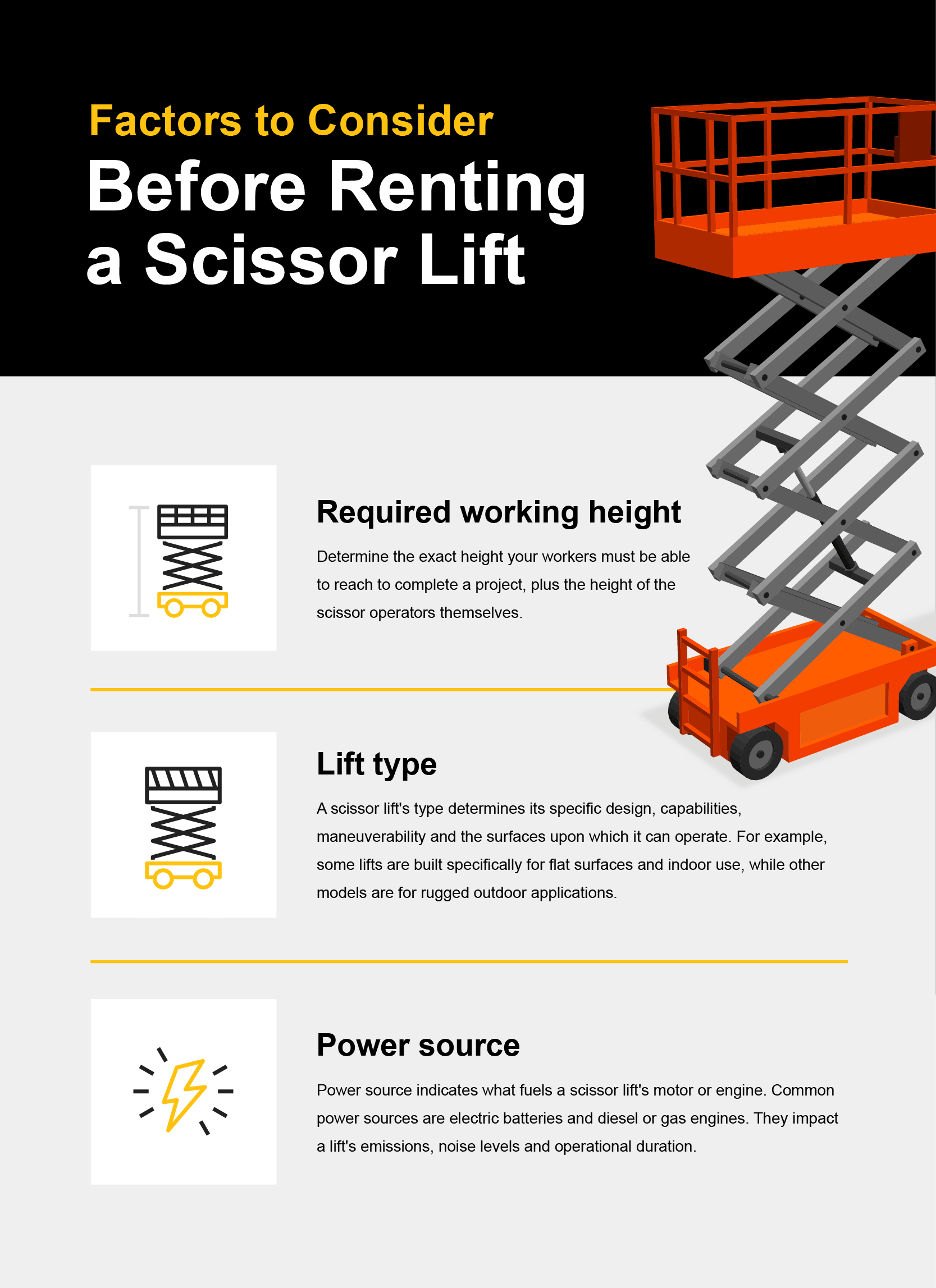
- Required working height: Determine the exact height your workers must be able to reach to complete a project, plus the height of the scissor operators themselves. More on that below.
- Lift type: A scissor lift's type determines its specific design, capabilities, maneuverability and the surfaces upon which it can operate. For example, some lifts are built specifically for flat surfaces and indoor use, while other models are for rugged outdoor applications.
- Power source: Power source indicates what fuels a scissor lift's motor or engine. Common power sources are electric batteries and diesel or gas engines. They impact a lift's emissions, noise levels and operational duration.
Focusing on all three of these factors is essential because they work together to support your application. The required working height establishes your initial boundaries, which helps you determine the appropriate lift type. Finally, your jobsite's environment finalizes your power source choice.
Types of Scissor Lifts and How They Differ
Learn about different scissor types and how they differ from each other.
Electric Scissor Lifts
Electric scissor lifts are ideal for various work environments, but especially on hard, level surfaces in indoor areas, such as warehouses, retail spaces, data centers and interior construction sites. Since they have zero emissions, electric scissor lifts are the only safe option for enclosed spaces. They also operate quietly. You can find electric scissor lifts in standard and compact sizes.
A slab scissor lift is a specialized type of electric scissor lift with a low ground clearance, compact chassis and non-marking tires. These features make slab scissor lifts perfect for smooth, firm and level surfaces such as concrete or finished flooring that require extra protection.
You can also opt for a dual-rated slab scissor lift, which features a dual-zone control system for indoor and outdoor use.
Diesel Scissor Lifts
Diesel scissor lifts run on diesel fuel and offer longer run times than electric forklifts. These scissor lifts are designed for use on firm, level ground such as stadiums, parking lots and large-scale outdoor construction sites.
A diesel scissor lift's emissions make it unsuitable for enclosed spaces, but its robust chassis and powerful engine help it handle tough outdoor applications. While electric scissor lifts are expanding in range, diesel remains an essential option for demanding situations.
Rough Terrain Scissor Lifts
Rough terrain scissor lifts are larger, heavier and more powerful machines that excel at navigating rough terrain such as sand, dirt and mud.
A rough terrain scissor lift features pneumatic tires that can grip uneven ground without popping. Some models also include oscillating axles and a 4WD system for excellent traction, stability and maneuverability on uneven terrain. Rough terrain scissor lifts come in electric and diesel models.
Choosing the Right Scissor Lift Height
Calculating the lift height you need for a job is one of the most important factors when selecting a scissor lift. Selecting the right lift height enables your workers to reach their work areas safely and comfortably, whether they retrieve pallets from shelves, paint walls or install roof components.
Understanding Platform Height vs. Working Height
Platform height is how high a scissor lift's platform rises. Working height is the lift's platform height plus approximately six feet (6'), which accounts for the height of an operator standing and working from the platform. For example, you would need a roughly 14-foot platform height if your workers need to work 20 feet above the ground.
To ensure you select a scissor lift with the ideal reach for your application, pay close attention to its working height. You need a lift with a working height that matches the height your workers need to access, whether it's the top shelves in your warehouse or outdoor construction framing.
Common Scissor Lift Working Heights and Their Ideal Applications
The three most common lifts available for rent are compact electric scissor lifts, electric scissor lifts and rough terrain scissor lifts. Each type offers its own maximum working height: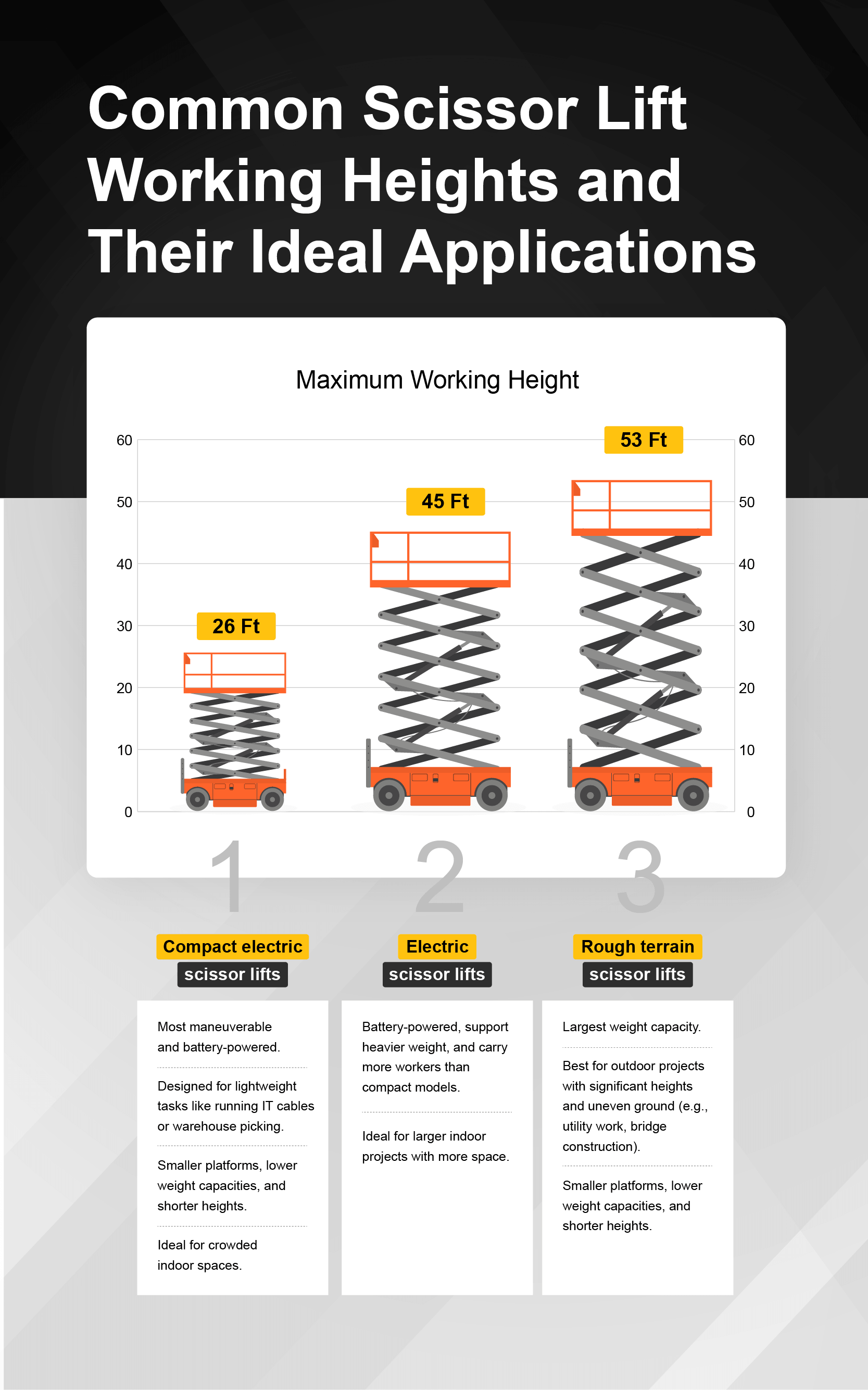
- 26-foot maximum working height: Compact electric scissor lifts can have a maximum working height of up to 26 feet, and they are the most maneuverable models. These battery-powered lifts are designed for lightweight tasks, such as running IT cables or warehouse picking. Their smaller platforms, lower weight capacities and shorter heights make them perfect for crowded indoor spaces.
- 45-foot maximum working height: Electric scissor lifts offer working heights up to 45 feet. These lifts are also battery-powered, but they can support heavier weight and carry more workers than compact models. An electric scissor lift is ideal for larger indoor projects where your team has more space to work with.
- 53-foot maximum working height: Rough terrain scissor lifts have maximum working heights of up to 53 feet and the largest weight capacity. These powerful lifts are best for working on outdoor projects with significant heights and uneven ground, such as utility work or bridge construction. You can find diesel, gasoline and hybrid options.
Overhead Clearance and Weight Capacity
The lift you choose must be able to safely fit under structural elements and through doorways at partial and full extension. Measure your facility or jobsite's spaces from the lowest point of each doorframe to the floor. Do the same for structural elements the lift must pass under.
Weight capacity is another vital consideration. A lift platform's weight capacity indicates the total weight it can handle, combining tools, workers and materials. Staying within a platform's weight capacity is crucial for safety and OSHA compliance. Consider the full weight of your lift operators and the tools and materials they will need with them on the platform.
Additional Scissor Lift Features
You can also consider various features you may need for certain tasks. Scissor lifts often come with a combination of features, such as:
- Extra decks or extendable work platforms
- Automatic parking brakes
- Extendable guardrails
- Integrated motion alarms
- AC outlets
- Tool trays or storage
- USB ports
How to Choose a Scissor Lift for Your Application?
Once you understand the lift type, height and weight capacity you need, assess your specific application.
Construction Sites
On construction sites, the type of lift you need often changes as the project progresses. Because of this, you may need to rent different scissor lifts at different phases of the same project.
Early-stage construction tasks, such as steel erection, often require rough terrain lifts due to working on uneven ground. Your team will typically need electric or slab lifts once you start working on an enclosed, floored building. Construction crews often depend on electric and slab lifts for mechanical, electrical and plumbing rough-in. For exterior cladding work, the type of lift you need depends on whether the ground is level.
Warehouses and Distribution Centers
Electric slab lifts are often the perfect solution for warehouse and distribution center work. Consider these factors when choosing a lift for your facility's needs:
- Aisle width: Narrow scissor lifts are necessary for navigating tight racking environments and crowded spaces. Measure your aisle widths to select a lift that can easily move in each workspace.
- Floor load ratings: Your building's floors must be able to support a lift's total weight, including workers and materials on the platform. Compare your facility's floor load ratings to the machine's total working weight before selecting a model.
- Battery life: Maximizing uptime is essential in a busy warehouse or distribution center. Consider a scissor lift's battery life to ensure it can last an entire work shift or multiple shifts with quick charging. Choosing a lift with an adequate battery life for your needs helps ensure continuous operation, productivity and workflow efficiency.
Facilities Maintenance and Property Management
Electric lifts are best for most interior maintenance jobs. As a facility or maintenance manager, you may need to rent a lift on short notice for reactive maintenance tasks. Whether you need to access the roof, work on lighting or maintain an HVAC system, having a trusted rental partner with a broad inventory is essential. With a wide selection from which to choose, you can find the exact lift type, height and weight for every maintenance job.
When a Scissor Lift Isn't the Right Tool
While scissor lifts are excellent options for many commercial and industrial applications, they are not the best option for every job. A scissor lift moves vertically, allowing operators to move up and down but not horizontally. A boom lift may be necessary if your workers need to work at irregular angles. Articulating or telescoping boom lifts are best in situations requiring horizontal reach.
Scissor Lift Rental vs. Purchasing
When you know the scissor lift type, size and weight necessary for your application, you can opt to rent or purchase the machine.
When to Rent a Scissor Lift
Scissor lift rental has a lower up-front cost than a purchase, requires no long-term storage and allows you to swap models as needed. It also reduces your maintenance requirements because the rental company takes care of equipment maintenance for you.
Renting is the best option for:
- Temporary projects: If you have a temporary project or task that requires a certain type of lift you don't typically use, renting allows you to use the lift without making a significant investment.
- Short-term or seasonal work: Your team might perform certain work seasonally or for a short period each year. Renting a scissor lift is often the most cost-efficient option in these cases.
- Model testing before purchase: You can test different scissor lift models before deciding on a final purchase. Rent a lift or multiple lifts to determine how well they work on your jobsite and meet your needs.
- Lack of transportation or storage: Renting equipment can help you save costs on long-term storage and equipment transportation. You can work with a rental company that delivers equipment directly to your jobsite.
When to Buy a Scissor Lift
Buying a scissor lift is often the best option when you plan to use the equipment regularly and for an extended time. When you use the equipment often, your initial investment delivers a higher return on investment.
Choose the Right Scissor Lift for Your Needs
Choosing the right scissor lift for each application results in safer, more productive and more efficient operations. When you consider your project's application, jobsite conditions, overhead clearance and weight requirements, you can match it to the perfect machine. Working with a knowledgeable equipment rental company can help you select and find the perfect lift for your next project.
OSHA Disclaimer
OSHA requires mobile work platform operators to receive training and authorization before operating scissor lifts. Each operator should complete a thorough pre-use inspection, use proper fall protection and follow the lift's manufacturer load limits. It's also important to comply with all applicable American National Standards Institute (ANSI)/Scaffold and Access Industry Association (SAIA) A92 standards. Employers must ensure each mobile work platform operator receives training on the specific equipment they operate.